![[PukiWiki]](image/pukiwiki.png "[PukiWiki]")
OpenCV Advent Calendar 2015 26日目
Random number generator. It encapsulates the state (currently, a 64-bit
integer) and has methods to return scalar random values and to fill
arrays with random values. Currently it supports uniform and Gaussian
(normal) distributions. The generator uses Multiply-With-Carry
algorithm, introduced by G. Marsaglia (
<http://en.wikipedia.org/wiki/Multiply-with-carry> ).
Gaussian-distribution random numbers are generated using the Ziggurat
algorithm ( <http://en.wikipedia.org/wiki/Ziggurat_algorithm> ),
introduced by G. Marsaglia and W. W. Tsang.
乱数生成器。内部に状態を保持し(状態は64bit整数)、
乱数スカラ値を返し、もしくは行列を乱数で埋める。
現在サポートされてるのは一様分布とガウシアン(正規)分布。
生成器は内部でMultiply-With-Carryアルゴリズムを使う。
G. Marsaglia ( <http://en.wikipedia.org/wiki/Multiply-with-carry> ) 導出。
ガウシアン分布の乱数はZigguratのアルゴリズム
( <http://en.wikipedia.org/wiki/Ziggurat_algorithm> ) を実装している。
#geshi(C++){{
#include <iostream>
#include <iomanip>
#include <opencv2/core/core.hpp>
const uint64 initState = 0x1234354435;
int main() {
	using namespace cv;
	using namespace std;
	RNG a(initState);
	for(int i = 0;i < 10;i++)
	{
		unsigned int randomNumber = a.next();
		cout << "0x" << std::hex << std::setw(8) << std::setfill('0') << randomNumber << endl;
	}
	return 0;
} }}
0xc4802924
0x6f670ec9
0x4ec21e44
0xe40ce671
0x5fcd40f9
0x3090cb5e
0x5d55db31
0x7145ce59
0xc5efc30e
0x7215b472
#geshi(C++){{ inline RNG::RNG(uint64 _state) { state = _state ? _state : 0xffffffff; } inline unsigned RNG::next() {
   state = (uint64)(unsigned)state* /*CV_RNG_COEFF*/ 4164903690U + (unsigned)(state >> 32);
   return (unsigned)state;
} }}
#geshi(c++){{
	int64 start = cv::getTickCount();
	for(unsigned int i = 0;i < iteration;i++)
	{
		a.next();
	}
	int64 finish = getTickCount();
	std::cout << "0x" << std::hex << a.next() << std::endl;
	std::cout << (finish - start) * second2ms / getTickFrequency() << "ms for generating " << std::dec << cIteration << " random #" << std::endl;
	std::cout << ((finish - start) * second2ms / getTickFrequency()  / cIteration) << "ms / 1 random #" << std::endl;
}}0xd497e65c 1.5647ms for generating 1000000 random # 1.5647e-006ms / 1 random #
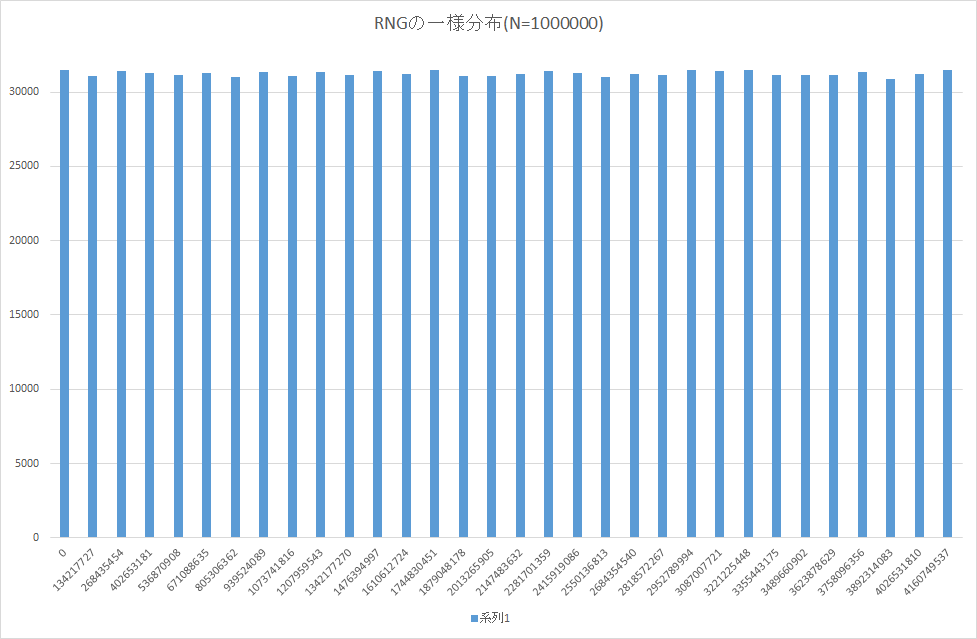
#geshi(c++){{ const unsigned int cIteration = 8000000; const double second2ms = 1000.0f; const double kSigma = 3.0f;
void checkEachBitVarianceGaussian(uint64 init, unsigned int iteration) {
	using namespace cv;
	RNG a(init);
	double foo = a.gaussian(kSigma);
	int64 start = cv::getTickCount();
	for(unsigned int i = 0;i < iteration;i++)
	{
		a.gaussian(kSigma);
	}
	int64 finish = getTickCount();
	foo = a.gaussian(kSigma);
	std::cout << (finish - start) * second2ms / getTickFrequency() << "ms for generating " << cIteration << " gaussian distributed random #" << std::endl;
	std::cout << ((finish - start) * second2ms / getTickFrequency()  / cIteration) << "ms / 1 random #" << std::endl;
	std::cout << foo << std::endl;
} }}
24.3736ms for generating 1000000 gaussian distributed random #
2.43736e-005ms / 1 random #
-0.965316
#geshi(c++){{
	using namespace cv;
	RNG a(init);
	unsigned int count[60]; //ヒストグラムのカウント
	memset(count, 0, sizeof(unsigned int)*60);
	// ヒストグラム作成
	for(unsigned int i = 0;i < iteration;i++)
	{
		double foo = a.gaussian(kSigma);
		int index = (int)(foo * 3 + 30);
		index = index <  0  ? 0  : index;
		index = index >= 60 ? 59 : index;
		count[index]++;
	}
	// ヒストグラム出力
	for(int i = 0;i < 60;i++)
	{
		std::cout << std::setw(2) << i << ' ' << ((double)(i-30)/3.0f) << '\t' << std::setw(7) << count[i] << std::endl;
	}
}}
#geshi(c++){{ Mat randomMat(RNG& rng, Size size, int type, double minVal, double maxVal, bool useRoi) {
   Size size0 = size;
   if( useRoi )
   {
       size0.width += std::max(rng.uniform(0, 10) - 5, 0);
       size0.height += std::max(rng.uniform(0, 10) - 5, 0);
   }
Mat m(size0, type);
   rng.fill(m, RNG::UNIFORM, minVal, maxVal); // ここで配列mを乱数で埋める
   if( size0 == size )
       return m;
   return m(Rect((size0.width-size.width)/2, (size0.height-size.height)/2, size.width, size.height));
} }}


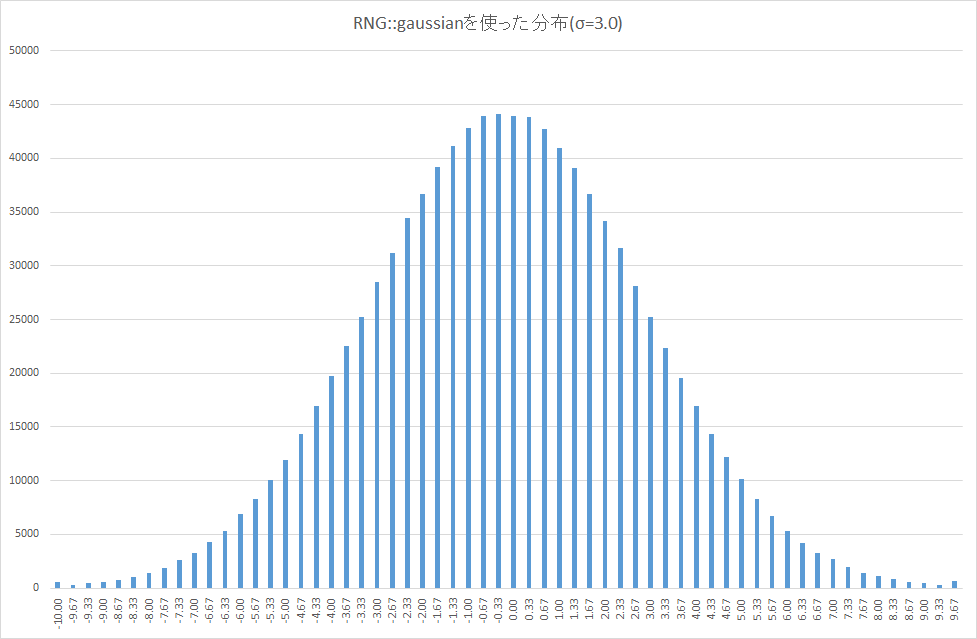 rng-gaussian.png
 rng-uniform.png
